
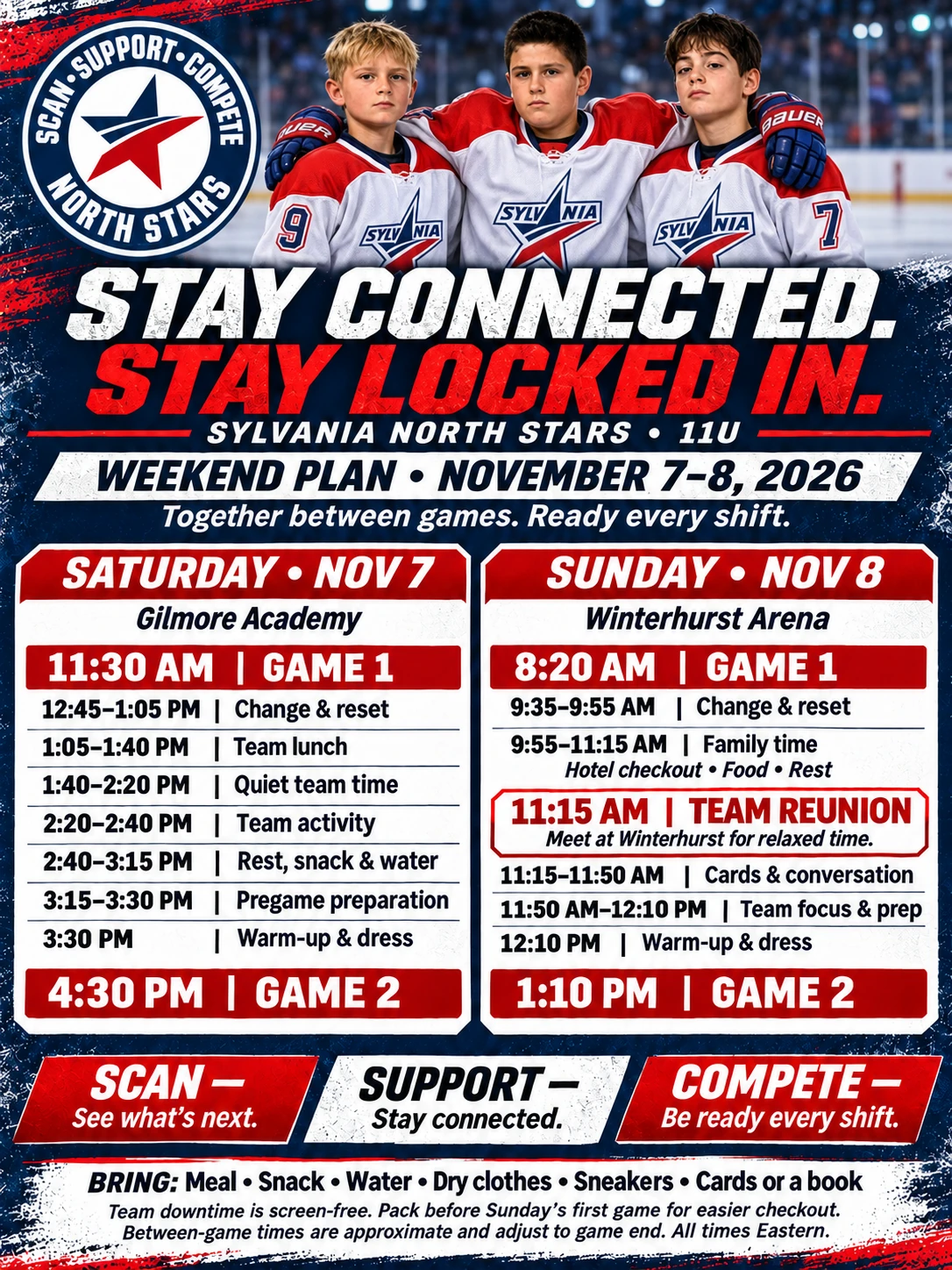
NOV7SAT
Bag check →
01
Team Schedule
Upcoming games, practices and tournament weekends from TeamSnap.
Add live TeamSnap calendar
Loading the latest TeamSnap schedule…
Thursday studio ice · 8:00–8:50 PM
Tam-O’Shanter · One group per Thursday, alternating weeks. Each assigned group gets the full 50 minutes. Check TeamSnap for your week’s group and any changes; calendar entries are forthcoming. Dressed and ready by 7:50 PM.
Group 1 · Jersey numbers 4–18
#4 Sellers · #7 Tawil · #8 Lyons · #9 Meier · #11 Beaudoin · #17 Urbaniak · #18 Hanhold
Goalie: #5 Willie Schoenrock
Group 2 · Jersey numbers 19–98
#19 Murawski · #23 Morris · #27 Barton · #30 McCann · #34 Pickett · #66 Kersey · #88 Sintic · #98 Trzcinski
Goalie: #29 Jayce Frasure
Week 9: Stay balanced. Stay connected. Next play.
Upcoming TeamSnap events
vs Ohio Prospects AAA · Game 1Gilmour AcademyView the between-game poster →
vs Ohio Prospects AAA · Game 2Gilmour AcademyView the between-game poster →
vs Team Cleveland Elite · Game 3Winterhurst ArenaView the between-game poster →
vs Team Cleveland Elite · Game 4Winterhurst ArenaView the between-game poster →
Tournament calendar
Fort Wayne Showcase
PSM Icehouse · Fort Wayne, Indiana
CCM Motown
Detroit, Michigan
The Coffey Cup
Mississauga, Ontario
Silver Sticks
St. Clair Shores, Michigan
CCM Shootout at Notre Dame
200x85 · Notre Dame, Indiana
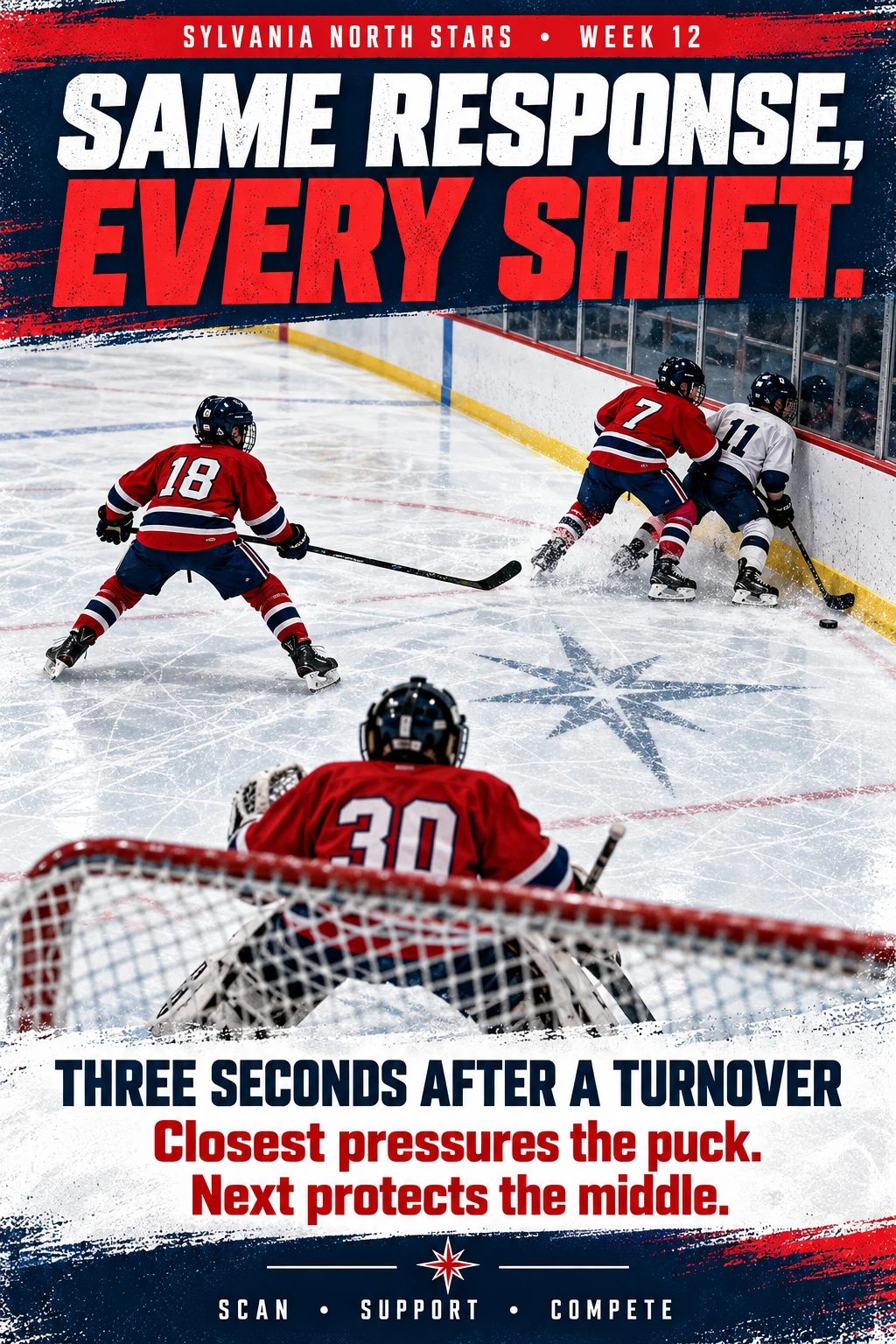
Tuesday · November 3 · Week 12
Film room: Protect the middle
Three videos. Follow the defender before the puck moves.
GAME-DAY VIDEO LESSON · OCTOBER 17
Pressure low. Protect high.
Before our 4:40 PM quarterfinal vs Heartland Black
One pressures. One supports. One stays above.Your mission: Watch the high forward—not just the puck. We can create chances and stay connected behind our attack.
Buffalo: stay high, cover the pinch
Find F1 pressuring and F2 helping low. Track F3 near the tops of the circles. When the defenseman goes down the wall, watch the forward fill behind him.
▶ Watch Buffalo NHL clip ↗Ice Hockey Systems · video opens in a new tabVegas: winger curls over the circle
Follow the board-side winger behind the faceoff dot and over the top of the circle. Vegas has the puck on this play. Below, we adapt that route when the puck goes to the opposite corner.
▶ Watch Vegas NHL clip ↗Ice Hockey Systems · video opens in a new tabOur faceoff-to-forecheck rotation
Left-side offensive-zone draw; puck goes to the right corner. This is our teaching diagram, not a tracing of either NHL clip. Reverse the routes for a right-side draw.
F1: Closest effective player pressures the puck. Here, the center goes.
F2: Support the battle and read the next pass. Give F1 a different route.
F3: Board-side winger curls high, then slides toward the middle above the puck. Feet moving, stick in a passing lane.
If our D goes: Fill behind him. The other defenseman moves early and protects depth.
Roles can switch: If the winger is closest and becomes F1, the center or other winger takes F3. Call “I’m high!” Do not send all three forwards below the puck.
Bring these three answers to the rink
- Who stays above our two low forwards?
- Where do you go when our defenseman advances?
- If the puck comes out, are your feet already moving?
SCAN the outlet. SUPPORT above the puck. COMPETE with moving feet.
Direct link to this lesson
02
Player Zone
October 28 practice: see it, support it, attack the next play.
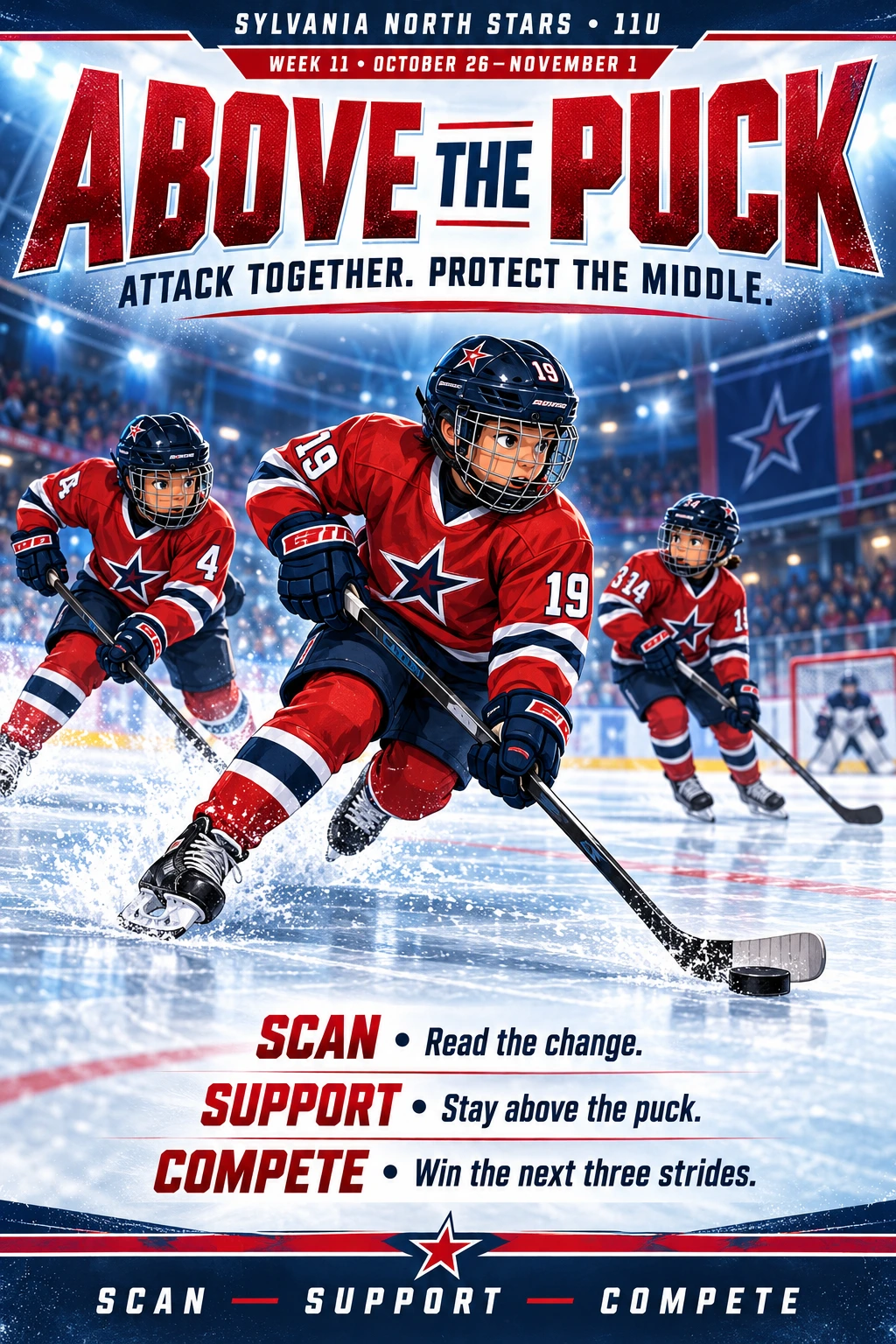
Week 11 · October 26–November 1 · Player mission
Above the puck.
Attack together. Protect the middle. Read the change, give your teammate a useful option above the puck, and win the next three strides when possession changes. SCAN — SUPPORT — COMPETE.
View the full poster →Start with skills, then connect through gates, attack and defend in 2-on-2, build our breakout, change sides with the hinge, and finish with Transition & Track.
- SCAN: Look before the puck arrives. Find the pressure, the middle and your next option.
- SUPPORT: Show your stick. Pass, then move to become available again. Help underneath on breakouts.
- COMPETE: On a turnover, get inside first, then pressure. Keep your stick in the lane and win the next three strides.
Before ice: Be fully dressed at Minus-10. After ice: What did you see? How did you support? Who got above the puck?
North Stars player cues adapted from the October 28 staff preparation sheet. Planned work; completion has not yet been recorded.
 COACH FAULKNER
YOUR DAILY TEAM MISSION
What do Coach Faulkner and my team need me to do today?
Wednesday practice · October 28: Look before receiving. Pass and move into new space. Lose it? Recover inside and protect the middle.
Review Above the PuckRead the change. Support the puck. Protect the middle.
Play three decisionsScan. Choose. Learn your next play.
Review my position’s jobChoose your position.
October 10 · Columbus Blue Jackets game prep
Coach Faulkner wants you to do this
HIGH D-ZONE EXITS · NEUTRAL-ZONE CONNECTIONS
Our mission: Get connected before we get fast. From the top of our circles through neutral ice, use short support passes, move again and carry speed into the next lane.
SCAN: Find the pressure and your next teammate before the puck arrives. SUPPORT: Give one close option, one option away and a safe option behind. COMPETE: Win your space, keep your feet moving after the pass and recover inside immediately if we lose it.
Against Columbus: When they pack the inside, make their coverage move with width and quick puck movement. If the middle opens, go north together. If it stays closed, use our partner and change sides.
Watch these four actual NHL gameplay clips in order. Tap each preview to open the source video. For clip 3, focus on the Kuznetsov sequence.
Matthews: arrive low, leave with speed
 Watch game footage ↗
Watch his route and timing on the retrieval. Our center stays available underneath the puck before accelerating into the exit. Center: scan first and build speed as the pass becomes available.
Watch video 1Ice Hockey Systems · opens a new tabYour read
Where can the center support without skating out of the passing lane?
Carolina: scan, receive, move it
 Watch game footage ↗
Watch the winger shoulder-check before the wall pass and move it on the forehand without extra stickhandling. Wing: know where the center and the pressure are before receiving. Use the open return lane; protect the puck when it closes.
Watch video 2Ice Hockey Systems · opens a new tabYour read
What must you see before the puck reaches your stick on the wall?
Kuznetsov: give it and fly
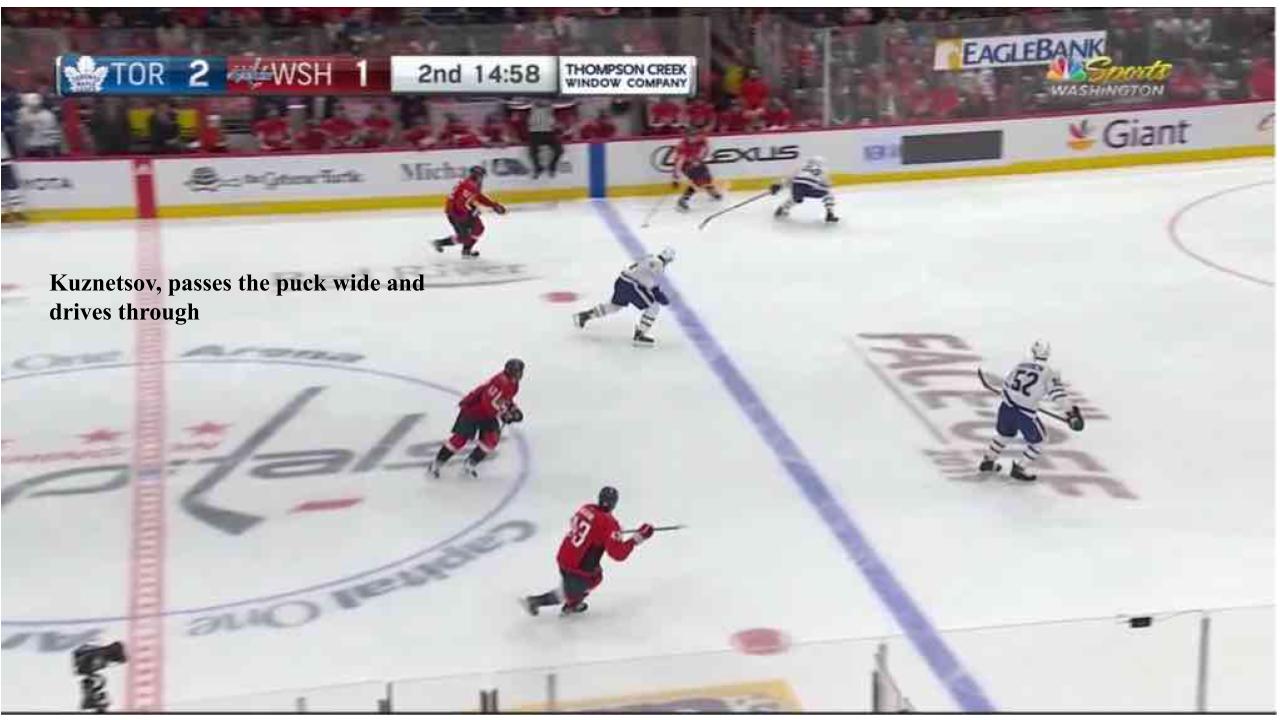 Watch game footage ↗
In the Kuznetsov sequence, watch the pass wide and acceleration through neutral ice for the return. Center: give it, keep your feet moving and show your forehand. Puck-side wing: put the return into the center’s path when it is open. Opposite wing: offer a separate lane.
Watch video 3Ice Hockey Systems · opens a new tabYour read
After the pass, where can you move to become available again?
Devils: D-to-D, hinge, go north
 Watch game footage ↗
Watch the first D-to-D pass, the receiving D widen, and the partner support behind and inside. That stagger creates the return lane. Our forwards move with the puck and show sticks for the next pass north.
Watch video 4Ice Hockey Systems · opens a new tabYour read
Why must the supporting defenseman be behind the puck, rather than level with the partner?
Our jobs before we cross their blue line
Support first. Accelerate next.
Center: stay underneath and available on the exit. Give to the wing, move into open ice and show your forehand for the return. Don’t fly away before we have a pass.
Be the outlet. Keep a second lane.
Puck-side wing: anchor on the wall with a ready stick and an early scan. Return quickly when the center’s lane is open. Opposite wing: stay in a separate support lane and move with the puck. Every line uses these reads.
OUT — BACK — THROUGH.
Take the clean forward pass. If it closes, use D-to-D with an open lane. The partner moves behind and inside for the hinge; receive moving, scan and connect north. Don’t force a pass through pressure.
Our quick pregame talk
- See it: Where is the first pressure? Where is our next pass?
- Connect: Center underneath → wall outlet → moving center, when the return is open.
- Change sides: Forward lane closed? D-to-D → hinge underneath → next open lane.
- Go again: Pass and move. On a turnover, recover through the middle and help win the next puck.
Our team cue: Scan early. Show your stick. Move the puck, move your feet. Our speed starts with support.
Earlier learning · Week 8
Our support and forecheck library
SCAN · SUPPORT · COMPETE
Watch each video, then answer in your own words. Explain what you noticed and why it matters. Bring your ideas to our next team discussion.
Matthews: Low Center Support
Scan the ice. Time your route. Stay available to your defenseman.
Watch NHL clip · Ice Hockey Systems · opens a new tabYour read
How does Matthews move to give his defenseman a passing option? If you were the center, what would you look for to decide where to go?
Carolina: Shoulder Check
Look before receiving. Know your next option. Move the puck promptly.
Watch NHL clip · Ice Hockey Systems · opens a new tabYour read
What can the winger learn by looking over his shoulder before receiving the puck? How would that information help you choose your next play?
Chicago: Pressure, Help, Protect
F1 pressures. F2 helps win the loose puck. F3 stays above the play.
Watch NHL clip · Ice Hockey Systems · opens a new tabYour read
Choose one forward and describe how his positioning helps his teammates win the puck. What could happen if all three forwards chased into the corner?
Buffalo: Pinch and Cover
Two work low. One protects high. Cover the defenseman who pinches.
Watch NHL clip · Ice Hockey Systems · opens a new tabYour read
When the defenseman moves down the wall, how does the high forward help keep the team protected? If you were that forward, what would you scan for before deciding where to move?
Our North Stars standard: Pressure with your feet and a controlled stick. Pinch only when the puck is reachable, a forward covers high and D2 has depth.
60 new situation cards · All 17 roster numbersScan · Support · Compete · Goaltending
Print 60 new cards →
15 new cards per category with numbered North Stars illustrations. Four cards per sheet with matching answer backs. Print all 30 pages on US Letter at 100%, double-sided, flip on the long edge. Cut on outlines.
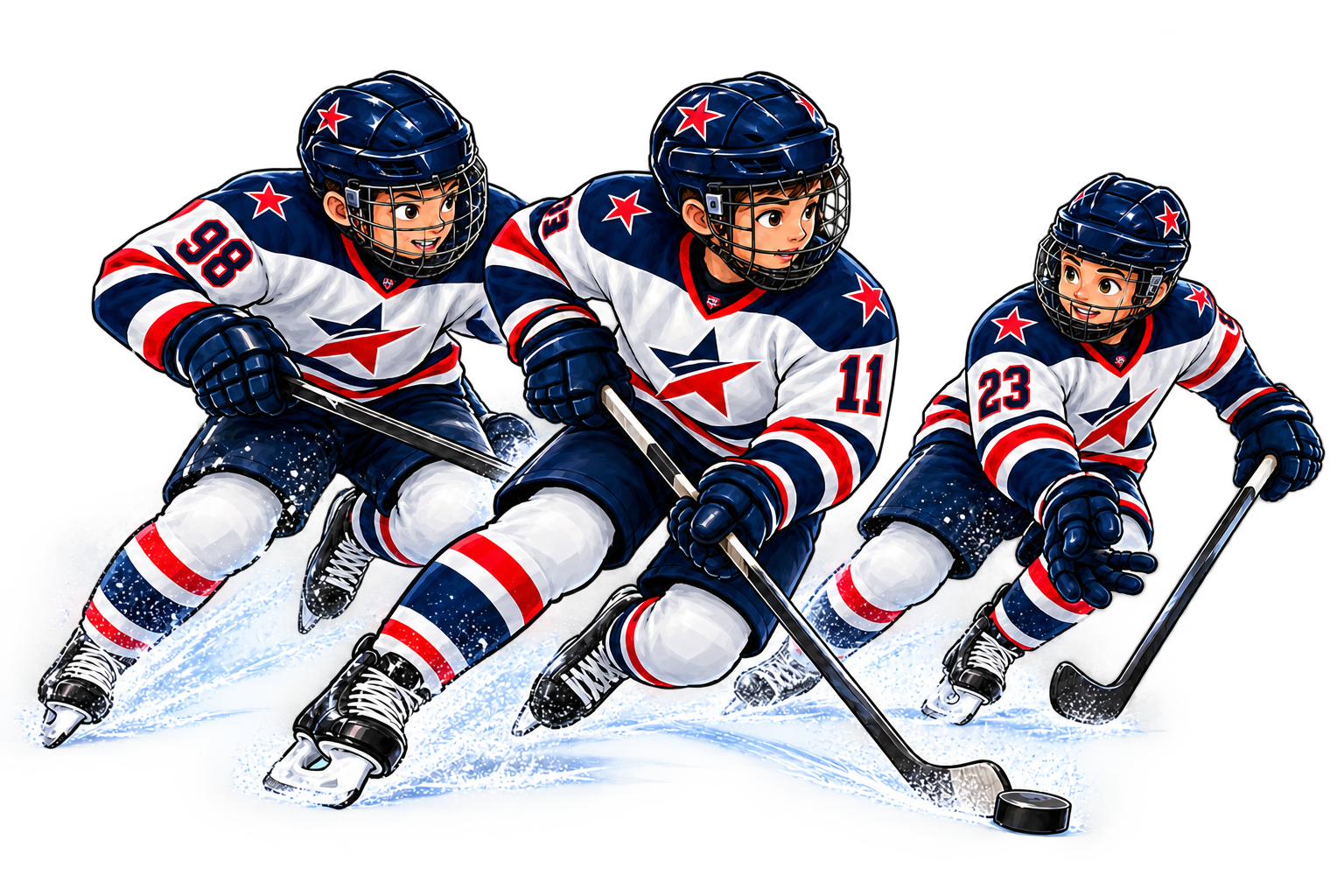
Every practice · every game
Ice time = T−0Ready at minus ten
For every practice, be fully dressed and ready in the locker room ten minutes before our scheduled ice time. This includes the limited-group small-ice sessions beginning the week of October 12 and matches our game-day readiness standard.
Protected
Player Development Passport
See how practice observations, game evidence and coaching priorities become a clear individual pathway.
Explore the system → LivePlayer Fuel Tracker
Build a game-day, practice-day or off-day fueling plan.
Open tracker → LiveGame-Day Bag Check
Player + parent equipment check before leaving home.
Start checklist → LiveHockey IQ Center
Scan, decide, execute—and learn how to Give Two.
Start mission → VideoWheel & Fly
Watch the faceoff win from a game view and a coach view.
Watch lesson → NewDefensemen: Own the Middle
Neutral- and grey-zone positioning built around five simple defensive calls.
Start defense lesson → NewForwards: Build the Triangle
Create one close option, one option away and move again after every pass.
Start support lesson → NewestTraffic Ahead? Use Your Team
See oncoming pressure, find support to the side or behind, and play connected.
Open support playbook → RecentHINGE: Your Safe Escape
Move behind, stay inside and give your partner a safe way out.
Learn the hinge → RecentGoalies: Stay in the Game
Find, set, talk, control and reset on every play.
Open goalie card →Stay current
Get Command Center alerts
Use an adult email address. We’ll send a short message when new Player Zone or Coaches Area material is published.
Defensemen
Own the Middle
Protect inside ice, control the gap and work together through the neutral and grey zones.
MIDDLEGAPSTEPHINGENORTH
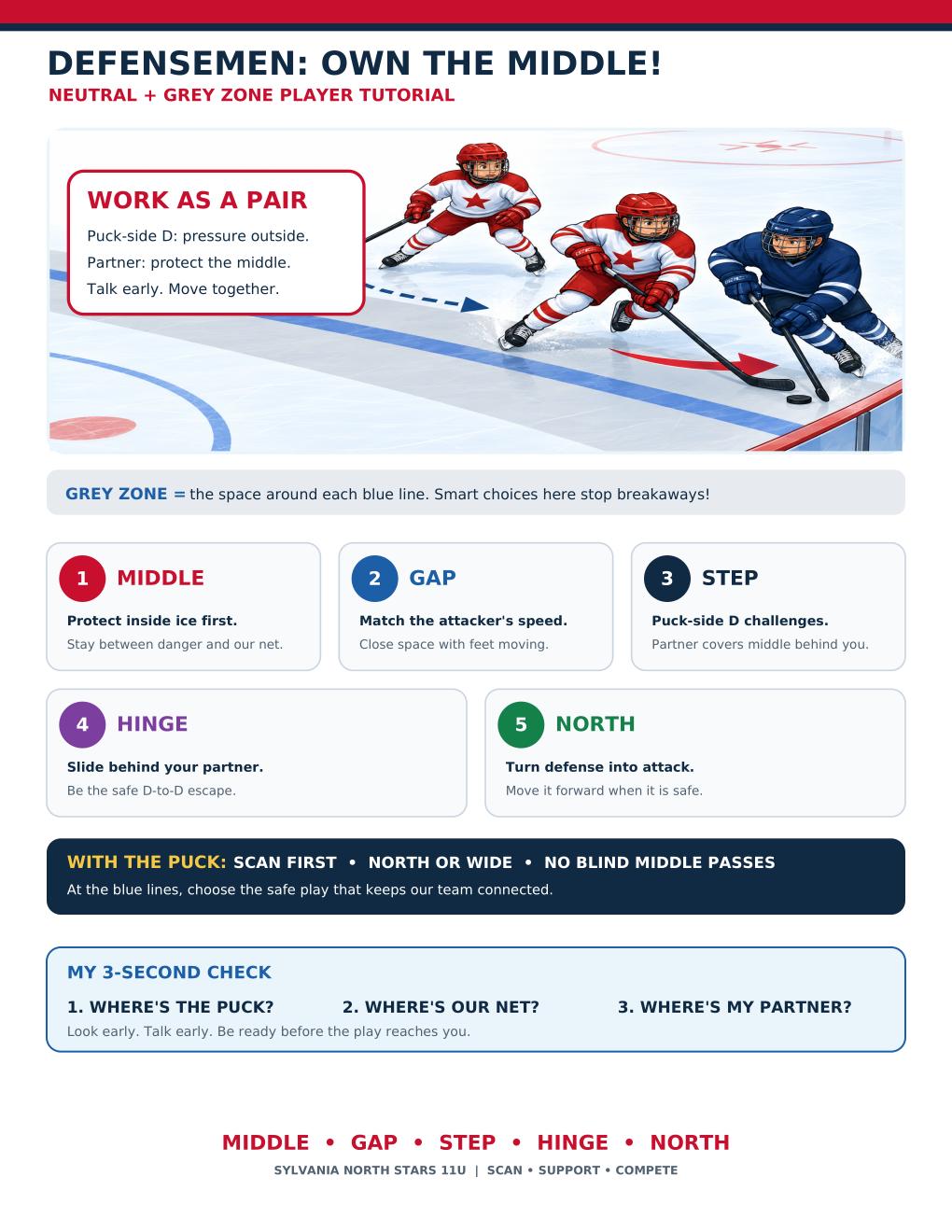
Watch the lessonControl the Gap
Player focus: match the attacker’s speed, protect the middle and close space before the blue line.
Forwards
Build the Triangle
Move with the puck to provide one close option, one option away and a new triangle after the pass.
CLOSEWIDEMIDDLEBEHINDMOVE
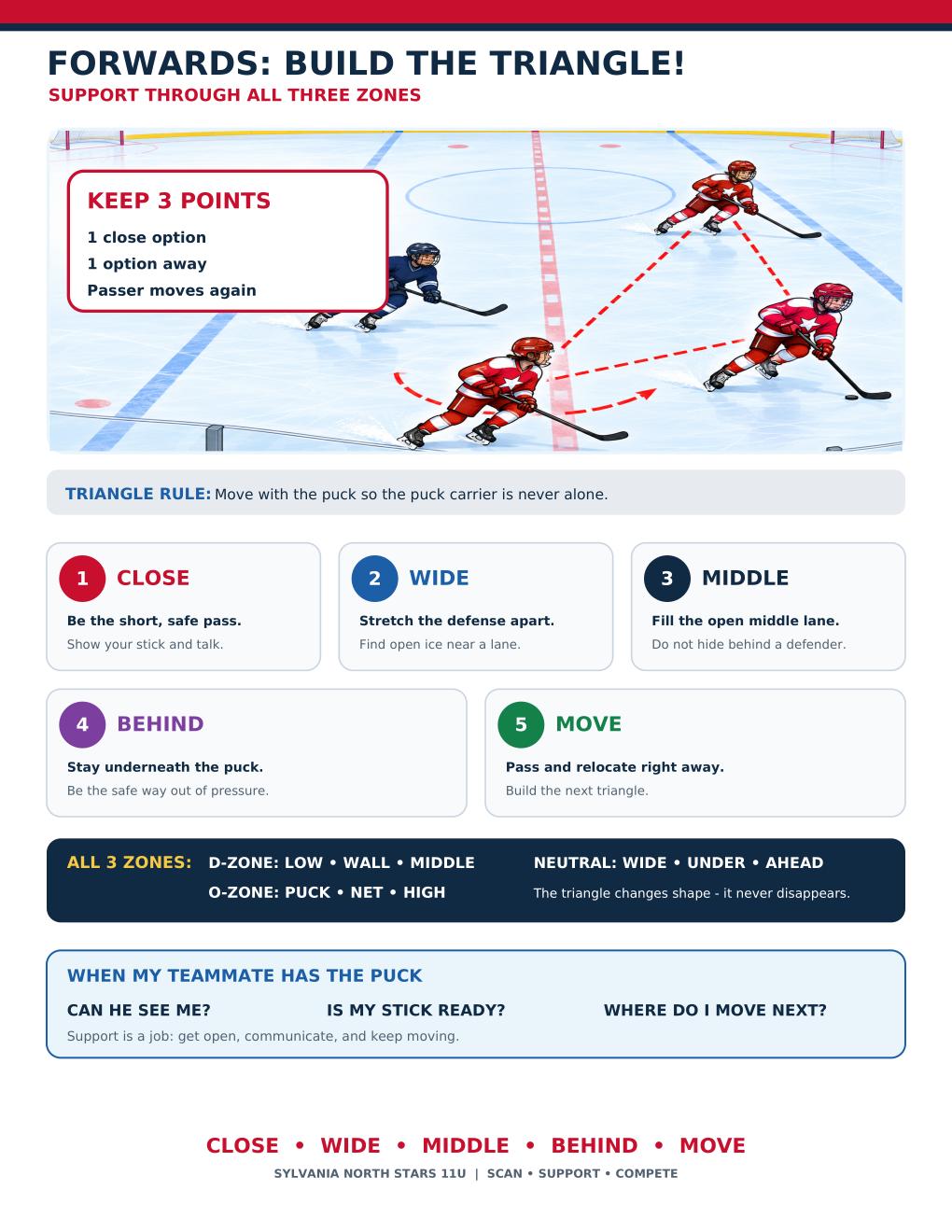
Watch the lessonSupport Your Puck Carrier
Player focus: give the puck carrier two visible options, keep a passing angle and move again after the pass.
Neutral-zone team play
HINGE: Your Safe Escape
When the way forward is blocked, your partner swings behind and inside to become the easy, safe pass.
LOOK FORWARDCALL HINGEMOVE BEHINDSTAY INSIDEFEET MOVING
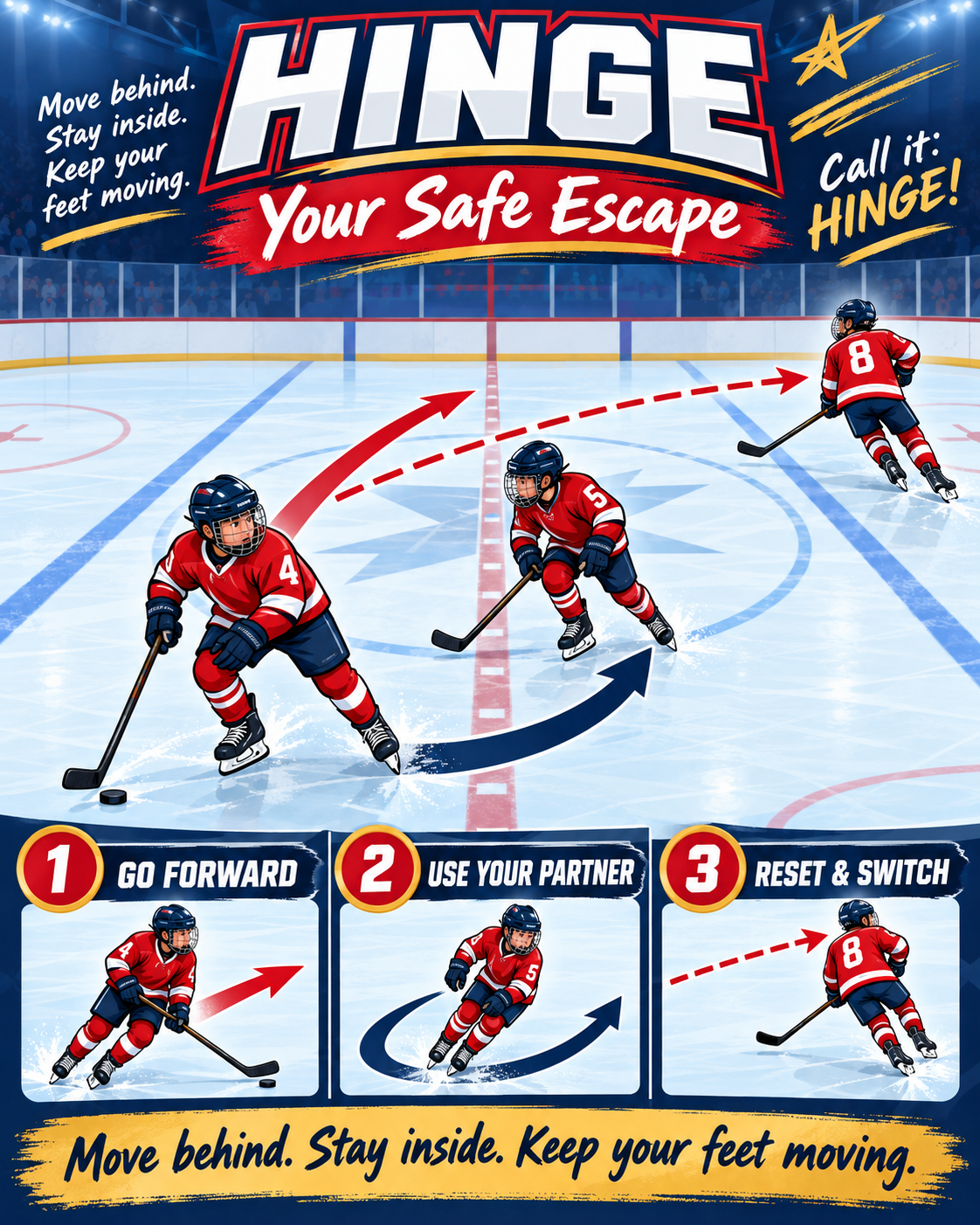
GO FORWARD
If the lane is open, attack it.
USE YOUR PARTNER
If pressure closes in, pass to the hinge.
RESET & SWITCH
Move the puck away from danger and attack the other side.
Watch the lessonDefensemen Hinge Play
Watch for: the partner moving behind, the pass arriving with feet moving and the attack switching to the open side. Our call: OUT — BACK — THROUGH.
Think of it like an escape door: your partner circles underneath so you are never trapped.
Open full-size HINGE page →Goaltenders
Stay in the Game
Your job starts before the shot. Stay connected to every play—even when the puck is 200 feet away.
FINDSETTALKCONTROLRESET
- 1FIND
Find the puck first. If you lose it in traffic, find it again before moving.
- 2SET
Get ready before danger arrives: feet set, knees bent, hands forward and stick down.
- 3TALK
Help your defense with short, early calls: “Time,” “Man on,” “Wheel” or “Leave.”
- 4CONTROL
Finish the save. Catch it, cover it or steer it safely to the corner.
- 5RESET
Take one breath, tap your posts and say, “Next puck.” Every play is a new play.
THE THREE-C REBOUND RULECatch it • Cover it • Corner it
Willie + Jayce: Be ready before the shot. Control the puck after the save. Reset immediately for the next play.
Watch the lessonKeep Your Focus All Game
Every game · one team clock
Game time = T−0
Your 60-Minute Pregame Countdown
Arrive
Bring your equipment inside, check in and get settled.
Dynamic warm-up
Join the team and move with purpose for 15 focused minutes.
Rehydrate + refuel
Drink, take in a familiar light fuel option and begin dressing.
Fully ready
Be dressed, equipment checked and ready for the coaches’ final message.
Game time
Play fast, support your teammates and compete.
Win the warm-up → bring the edge to the ice.
View 1Game perspective
Watch the Golden Knights execute it
See the center win, defenseman wheel, inside wing protect and fly wing stretch the ice in live game action.
View 2Coach perspective
Slow the play down and focus on the wheel route, weak-side space and timing of the outlet.
Watch for four things
1 · Win or bump it back2 · Wheel D scans behind the net3 · Inside wing delays pressure4 · Fly wing pushes their D back
Player question: “Do we own the puck?” If yes, wheel and fly. If no, stay inside and protect the house.
Scan
Look before you touch it.- Shoulder-check before the puck arrives.
- Find pressure and open ice.
- Make your decision early.
Player cue: “Where is the pressure?”
Support
Give the puck carrier two.- Be an easy passing option.
- Support at different depths.
- Pass, move and get open again.
Player cue: “Become option two.”
Compete
Win it. Move it. Reset.- Battle for possession.
- React within three seconds.
- Mistake? Reset and make the next play.
Player cue: “Next play!”
01 Scan → Decide → Execute
SCAN
Look over both shoulders before the puck arrives. Find pressure, teammates and open ice.
DECIDE
Choose early: skate, pass, protect or escape. Your first touch should move away from pressure.
EXECUTE
Commit to the play with speed. If it fails, recover within three seconds and make the next play.
02 Give Two
1 · Close help
One teammate gets close enough to be a safe, visible passing option.
2 · Different depth
A second teammate creates another lane—not flat and not hiding behind pressure.
3 · Move again
After passing, relocate immediately. The passer becomes the next option.
Pass → move → give the new puck carrier two options.
03 Team Communication
TIME
You have space. Get your head up and make a controlled play.
ONE
Pressure is coming. Make one quick, simple play.
REVERSE
Pressure has closed one side. Send the puck back to the open side.
04 Faceoff Mindset
Be ready
Know your position, opponent and first responsibility before the puck drops.
Win your job
The center battles for the puck. Everyone else wins body position and protects space.
React together
Win, lose or tie—the entire unit moves immediately to the next play.
Can you earn all three stars?☐ I scanned ☐ I supported ☐ I competed
03
Player Development Passport
A continuous development pathway built from what coaches see, teach and measure.
Public overview · no player data
Every player has a development pathway—not just a season stat line.
Technical skill development, hockey decisions and team-play habits are connected to practice observations and game evidence, then converted into clear individual goals that players and families can understand.
PLAYERDEVELOPMENTPASSPORTObserve · Plan · Teach · Measure
THE DEVELOPMENT CYCLE
Evidence becomes the next coaching decision
- 01Observe
Capture useful practice and game evidence.
- 02Evaluate
Identify what is emerging, consistent or needs support.
- 03Plan
Choose the next small, teachable priority.
- 04Teach
Connect the goal to drills, video and simple cues.
- 05Measure
Revisit the evidence and adjust the pathway.
ANONYMIZED DEMONSTRATION
Sample Player #12
This fictional profile demonstrates the family-facing experience. It contains no North Stars player information and does not reveal the private evaluation rubric.
Current development focus
Cycle 1Play connected before and after possession
SCANCheck both shoulders before the puck arrives.Player cue: “See it early.”
SUPPORTGive the puck carrier one short option.Player cue: “Become option two.”
COMPETERecover inside position after a turnover.Player cue: “Next job now.”
TECHNICAL SKILL DEVELOPMENT
Build the tools that make better decisions possible
The Passport tracks how individual skills improve and how consistently the player transfers them into practices and games.
Skating + balancePuck controlPassing + receivingShooting + release
Sample current target: Present the forehand, receive in motion and move the puck before pressure closes.
Evidence consideredPractice observationsGame momentsVideo reviewCoach follow-up
PUBLIC
What the program shares
- Development philosophy and cycle
- Fictional, anonymized examples
- Player and family experience
- Program benefits and outcomes
PROTECTED
What stays private
- Named evaluations and comparisons
- Coach observations and scoring logic
- Health, family and behavioral information
- Individual video and player records
ONE SYSTEM · FOUR VIEWS
Useful to everyone responsible for development
Know the next job
Clear technical-skill and decision-making priorities that can be carried onto the ice.
See real progress
Approved updates explain skill growth and game transfer beyond goals, assists and wins.
Teach with continuity
Observations become intentional skill work, practice design and follow-up.
Build a repeatable standard
A consistent development process that can extend across teams and seasons.
PLAYER DEVELOPMENT PASSPORT
See the system without exposing the players.
Public visitors can understand the value. Authorized coaches enter the protected working environment; families receive only approved reports for their player.
04
Video Learning Center
Short North Stars clips presented newest to oldest.
Tuesday · November 3 · Week 12
Film room: Protect the middle
Three videos. Follow the defender before the puck moves.
Week 8 · Find space. Show your stick.
Watch the Pros
SCAN · SUPPORT · COMPETE
Watch each video, then answer in your own words. Explain what you noticed and why it matters. Bring your ideas to our next team discussion.
Matthews: Low Center Support
Scan the ice. Time your route. Stay available to your defenseman.
Watch NHL clip · Ice Hockey Systems · opens a new tabYour read
How does Matthews move to give his defenseman a passing option? If you were the center, what would you look for to decide where to go?
Carolina: Shoulder Check
Look before receiving. Know your next option. Move the puck promptly.
Watch NHL clip · Ice Hockey Systems · opens a new tabYour read
What can the winger learn by looking over his shoulder before receiving the puck? How would that information help you choose your next play?
Chicago: Pressure, Help, Protect
F1 pressures. F2 helps win the loose puck. F3 stays above the play.
Watch NHL clip · Ice Hockey Systems · opens a new tabYour read
Choose one forward and describe how his positioning helps his teammates win the puck. What could happen if all three forwards chased into the corner?
Buffalo: Pinch and Cover
Two work low. One protects high. Cover the defenseman who pinches.
Watch NHL clip · Ice Hockey Systems · opens a new tabYour read
When the defenseman moves down the wall, how does the high forward help keep the team protected? If you were that forward, what would you scan for before deciding where to move?
Our North Stars standard: Pressure with your feet and a controlled stick. Pinch only when the puck is reachable, a forward covers high and D2 has depth.
Clip times below are approximate. Select an increment to replay it, or watch all 30 seconds.
Work near the wall
Red and blue converge near the far-side boards. Red has teammates inside and a high outlet available. Keep working while the next option develops.
Pause question: Where could the puck go next?Use the high option
The play moves away from the wall toward Lyons, who stays high and separated from the group. Pickett’s credited assist connects the puck to that available option.
Pause question: What makes Lyons available?Send the puck toward the net
Lyons sets and releases from high in the zone. Red teammates remain around the net as the shot arrives. The scoring sequence ends with Lyons’s goal.
Pause question: What is your job when a teammate shoots?Recognize the whole play
The red players come together after the goal. Replay the wall play, the high support and the finish: the scoring chance grows from connected actions.
Pause question: Which action helped create the shot?Get ready for the next play
The remainder shows the celebration and movement back toward center ice. Use this interval to reset attention and name one habit to repeat.
Player answer: Stay available above the puck.Scan
Before receiving, look for pressure, the open teammate and the route toward the net.
Cue: “Find the space.”Support
Give the puck carrier an outlet away from the crowded wall. Stay at a useful distance and keep your stick ready.
Cue: “Be available.”Compete
Keep working around the puck and the net. When the puck goes high, be ready for the shot and any second puck.
Cue: “Keep working.”Coach-approved analysis
Coach Faulkner approved this lesson on October 4, 2026, and confirmed the scorer and assist through LiveBarn. The wide camera view supports the spacing and sequence analysis; it does not clearly resolve individual head turns or the precise puck path through traffic. Early scanning and second-puck readiness are teaching cues, not claims that those actions can be verified in this view.
Week 7 · Team film
SCAN · SUPPORT · COMPETEWatch the play. Find the next decision.
North Stars in red · Fort Wayne, September 27
01 · Learn from it
Penalty kill: trust the goalie, find the next threat
Our positioning is good. Keep guarding the middle and checking sticks. After the corner player passes to the point, the back defenseman watches the shot toward the net. Trust the goalie to handle that shot and keep track of the passer coming out of the corner—he becomes the most dangerous player and scores. Not watching the puck is very difficult, even for high-level players. We are learning that habit now.
Player cue: Trust the goalie. Find the passer. Protect the middle.02 · Build on it
Grady McCann: space and patience
Red attacks with options at different depths. Watch how Grady stays available and lets the opening develop before the finish.
Player cue: Arrive with options. Find the opening. Finish.Regain + transition
Disrupt the advance and quickly turn play back toward offense.
Supported entry
Attack with width while teammates fill useful middle and far-side lanes.
Possession + recovery
Keep a high option, recover loose pucks and rebuild the attack.
Second-puck goal
Put the puck through traffic, arrive inside and compete through the rebound.
Scan
Look before the puck arrives. Find pressure, teammates and the next useful play.
Cue: “See it early.”Support
Give the puck carrier a close option, a different-depth option and safety above the puck.
Cue: “Give two.”Compete
Recover the loose puck, get inside and continue after the first chance.
Cue: “Next puck.”Why this goal matters
The goal is not one isolated play. It is the result of connected decisions and five players continuing after the original attack does not immediately work.
Scan before arrival
Check the middle, the wall and pressure while approaching the puck—not after collecting it.
Open to the ice
Receive with feet and shoulders positioned so the first touch can move away from pressure.
Keep support spread
One close option, one middle option and one player above the puck prevent everyone from arriving in the same lane.
Stay disciplined
When the exit breaks down, reload underneath, move your feet and avoid a desperate reach or chase.
Scan
Look over both shoulders before the puck arrives. Find pressure, the middle and your safest outlet.
Cue: “Shoulders first.”Support
Stay in a different lane and at a different depth. Do not skate toward the puck carrier and remove space.
Cue: “Spread the ice.”Compete
If the first play fails, recover inside position with active feet and sticks—without taking a penalty.
Cue: “Feet, not reach.”The correction
Scan before the puck arrives, open your body toward usable ice and make the simple first play. Early information creates a cleaner exit; late information creates traffic.
Build the shape
Stay spread so the penalty killers cannot cover the puck, the point and the net with one player.
Support low to high
Barton helps keep possession connected and gives the puck a route back to Urbaniak.
Get it through
Urbaniak scans, avoids the first blocker and delivers a low, reachable point shot.
Stick on puck
Trzcinski holds inside ice, presents his blade and changes the puck’s direction at the net.
Scan
Urbaniak finds the shooting lane. Trzcinski reads the defender, the goalie and the path of the shot.
Cue: “See the lane.”Support
Barton stays connected underneath the puck and helps turn possession into a low-to-high attack.
Cue: “Connect the play.”Compete
Trzcinski earns inside position, keeps his stick free and redirects the shot before the goalie can adjust.
Cue: “Stick ready.”Why this goal matters
The goal is finished at the net, but it is created by connected support, a point shot designed to be tipped and a net-front player ready for the touch.
More lessons
Keep Learning
Use these existing Player Zone lessons to connect the game clip to our team concepts.
Faceoff + breakout
Wheel & Fly
Watch the five players move as one unit from a defensive-zone faceoff.
Open lesson → DefenseOwn the Middle
Control the gap, protect inside ice and close space before the blue line.
Open lesson → ForwardsBuild the Triangle
Create two visible options and move again after every pass.
Open lesson →
05
Parent Hub
Schedules, preparation and team information.
Practice + game standard
Ice time = T−0Fully dressed at T−10
For every practice, please plan so your player is fully dressed and ready in the locker room ten minutes before scheduled ice time. This includes limited-group small-ice sessions beginning the week of October 12. Monday and Wednesday preparation may differ, but the ready time is always T−10. TeamSnap remains the source for the schedule.
Request
Player Development Access
Ask to view your player's private development record using your Google account email.
Prepare request → LiveBefore You Leave
Complete the equipment and helmet check with your player.
Open checklist → LiveNutrition Guide
Flexible food and hydration ideas for active 11U players.
View guide → LiveTeam Schedule
Games, practices, meetings and tournament weekends.
View schedule →Player + parent · one team clock
Game time = T−0
60-Minute Pregame Countdown
Arrive
Player and equipment are inside the rink. Check in and get settled.
Dynamic warm-up
The team begins its 15-minute warm-up together.
Rehydrate + refuel
Player drinks, uses a familiar light fuel option and begins dressing.
Fully ready
Player is dressed, equipment checked and ready for the coaches.
Game time
The team takes the ice ready to compete.
Win the warm-up → bring the edge to the ice. TeamSnap remains the official source for game time.
Pack + recover
- Complete the bag and helmet check.
- Confirm game and arrival times.
- Set clothes, water bottle and food aside.
- Protect a consistent bedtime; reduce late screen time.
Fuel steadily
- Eat normal balanced meals—do not skip lunch.
- Drink water throughout the day.
- Pack a familiar after-school snack.
- Avoid experimenting with new foods on game day.
Top off energy
- Choose familiar carbohydrate + protein foods.
- Ideas: turkey sandwich, chicken and rice, oatmeal with eggs, or yogurt and fruit.
- Keep portions comfortable—not a strict menu.
Hand over ownership
- Arrive by the TeamSnap arrival time.
- Player carries and manages his own equipment.
- Keep instructions simple and positive.
- Let coaches coach; enjoy watching him compete.
CCM Detroit tournamentOpen tournament waiver →
EquipmentComplete bag check →
NutritionBuild a fueling plan →
CalendarAdd TeamSnap schedule →
The ride home
Start with support: “I loved watching you play.” Save detailed hockey instruction for the coaches and the next practice.
06
Coaching Room
Restricted planning and player-development resources.
Coach access is controlled in Google Drive. Links may require permission from Head Coach David Faulkner.
Printable coach’s notes (PDF) · IHS practice sheet with diagrams and jersey groups · 33-week development plan
Monday · 50 minutes on half ice
0–10 Coach Beaudoin leads skills. Finish with three hard strides after a change of direction. 10–11 Demo both jobs on one turnover.
11–40 Split 14 skaters into groups of 5, 5 and 4. Run three 9-minute stations with 1-minute moves at 20 and 30. Play 2v2 and rotate the fifth skater in every 25–30 seconds.
- Net to Corner · goalie in. Chip to the wall. Watch the second defender see both the puck and the player in front. “Your partner has the wall. Take inside.”
- Open-ice puck race · no goalie. The winner shields and passes. Closest defender angles the carrier wide while their partner closes the inside pass. “Take inside ice first.”
- 2 vs 2 Corner Battle Tag Up · goalie in. On a turnover, the new attackers tag up at the goal line. Watch the former attackers start defending before the tag. “Go on the turnover.”
40–42 Set two nets cross-ice with Red and White outlet pairs on the dots. 42–50 · 2 on 2 Transition & Track. Defenders win possession and pass to their outlets. Former attackers turn and track. Practice sheet and drill source
Weekly bench cues · SCAN / SUPPORT / COMPETE
Scan “Who’s in the middle?” Support “Partner on the puck? Get inside.” Compete “Three hard strides. Angle them wide.”
Monday, name the jobs. Midweek, listen for “I’ve got puck!” and “I’ve got middle!” In the final game tonight and again on the weekend, tally the last five turnovers. Count a win-back or pressure plus inside coverage within three seconds. Recognize the player who took away the pass.
Sources & references — coaching materials and online resources →
Weekly development journal — head coach only →
Parent coaching feedback — head coach review & closing date →
Open October 28 printable coaches’ notes ↗ · Owner’s saved staff sheet; access depends on the signed-in account.
Drill sequence · Proposed 60-minute timing
- Skills with Coach Beaudoin — 8 minutes. Eyes up, feet moving, next action ready. “Look first. Move your feet.”
- 2/3 Gates Passing Goalie Warm-Up — 8 minutes. Pass through one gate in each zone; relocate after every pass. Add F3 once connected. “Show your stick. One above, one ahead. Finish under control.”
- Short to Long 2 on 2 — 8 minutes. Attack with width and changing lanes; defenders close the gap and protect inside. “Attack together. Defend inside out.”
- BC 3 on 2 Breakouts — 10 minutes. Low center stays available; solve pressure with feet and short support. “Look before retrieval. Direct if open; support if closed.”
- Clone O/S Hinge — 12 minutes. Scan across, time forward routes and rotate the passing side. “Move the puck, change the angle. Arrive available. Reconnect.”
- 2 on 2 Transition & Track — 10 minutes. Win it, find the outlet and attack; former attackers track through the middle. “Lose it? Inside first, then pressure. Stick in the lane.”
Timing: 56 minutes of drills + 4 for explanations, transitions and close. These are proposed trims from the 62-minute IHS sequence reported in the staff sheet. Protect the final live game. Transition & Track is drawn cross-ice in IHS; demonstrate any adaptation before starting.
Staff priorities and evidence
- SCAN: Look before receiving: puck, middle, next threat. Praise the read as well as the completed pass.
- SUPPORT: Give two useful options in three-player reps; pass and relocate. On finishes, build low, net and high support when numbers allow.
- COMPETE: Begin the next job within three seconds of a turnover. Above means toward our own net and close enough to help; protect the middle before chasing.
Walk each rotation once; use one teaching cue per rep. Rotate repeated defensemen in Short to Long and Hinge. Watch five live possession changes for scanning, relocation and inside recovery. If one correction repeats twice, change the space or constraint.
Confirmed Monday evidence: Strong movement without the puck, outlet passing, puck battles and net-front play. Wednesday question: Do those behaviors transfer to larger space and live transitions? Wednesday attendance and completed-drill observations are not yet recorded.
Close: What did you see? How did you support? Who got above the puck?
Previous session · Monday, October 26
Monday practice PDF and diagrams ↗ · Monday coach cue sheet ↗
Source: North Stars Coaches Notes, October 28, 2026; Monday observations: Coach Faulkner’s October 26 coaching notes. North Stars timing and teaching adaptations; IHS drill titles preserved as recorded in the supplied staff sheet. Original IHS pages have not been independently rechecked.
Inspired by Steve Jobs’ long view of people: use today’s problem to build tomorrow’s capability. Our hockey application is SCAN · SUPPORT · COMPETE—observe, teach and give the player another opportunity.
When an issue develops: our coaching process
- Pause and scan. Settle our own reaction. Describe the specific action without labeling the player. Check understanding, skill, readiness and emotion before deciding what caused it.
- Ask and listen. “What did you see?” “What were your options?” “What made that difficult?” Let the player explain before giving the answer.
- Support one learning need. Choose one clear cue, demonstrate if needed, and have the player explain his next action. Adjust the teaching or practice environment when that is the missing piece.
- Compete with ownership. Give a realistic retry. Ask the player to choose and execute the solution. Maintain effort, respect and team standards; address unsafe actions immediately.
- Review and follow through. Notice the improved decision, even if the result is imperfect. Recheck at the next shift or practice. Record the cue and evidence of progress in the appropriate coaching notes.
Individual conversation · A simple bench script
“Tell me what you saw. What could you try next? Here is one cue to help. Show me on your next shift, and we’ll check it together.”
Keep corrections calm and specific. Discuss sensitive or repeated issues privately. If the player cannot yet execute the solution, simplify the task and teach it again.
Team issues · Fix the learning environment
Describe the shared pattern without naming or blaming players. Ask the group what they notice, agree on one behavior, rehearse it, then review it together. Captains help model and reinforce the standard; coaches remain responsible for teaching and follow-up.
Example: low energy between games. Ask what helped or hurt readiness. Teach a shared food, hydration, rest and warm-up routine, assign responsibilities, then review how prepared the team was for the next opening shift.
Apply it to our hockey priorities
- Missed scan or breakout read: Ask what pressure the player saw; rehearse the shoulder check and one available outlet, then replay with pressure.
- Support and spacing: Ask where a teammate could receive help; freeze the picture, let the player find the lane, then restart.
- Reaching penalty: Reset emotion, identify the feet-and-body position, rehearse stick discipline, then check the next battle.
- Emotional reaction: Help the player settle, identify what is controllable, choose a next-play action, and recognize the reset.
- Goal against: Ask the goalie what he tracked and what he needs next; choose one positioning or reset cue, then return to the next shot.
Follow-up prompt: Situation → player’s view → learning need → agreed cue → retry → review date → progress observed. Keep individual observations in protected coaching records.
Watch the inspiration: Steve Jobs on developing people ↗ · Original MIT talk ↗
North Stars coaching adaptation. This is a standing development principle for future team and individual issues.
60 new situation cards · All 17 roster numbersScan · Support · Compete · Goaltending
Print 60 new cards →
15 new cards per category with numbered North Stars illustrations. Four cards per sheet with matching answer backs. Print all 30 pages on US Letter at 100%, double-sided, flip on the long edge. Cut on outlines.
Planned groups · 12 skaters + 2 goalies
Red: #7 Tawil, #8 Lyons, #9 Meier, #11 Beaudoin, #18 Hanhold, #19 Murawski.
White: #27 Barton, #30 McCann, #34 Pickett, #66 Kersey, #88 Sintic, #98 Trzcinski.
Goalies: #5 Schoenrock, #29 Frasure.
Availability: #4 Sellers out 10–14 days with an injury; #17 Urbaniak remains out; #23 Morris away at sixth-grade camp. Groups are planned availability, not a completed attendance record.
Drill sequence and coaching cues
- Skills with Coach Beaudoin — 12 minutes. Connect edges, balance and moving feet to escaping pressure and being ready to receive.
- Picket Fences — 10 minutes, each end. Attack the net for two points; defenders earn one by skating possession through the gate. Keep the assigned offensive/defensive roles for each short rep, then switch. Cue: “Find an angle. Help the puck carrier.”
- BC 3-on-2 Breakouts — 12 minutes. Two defensemen and one low forward solve two forecheckers. No rimmed exits. Low support stays available; escape pressure before transitioning. Cue: “Look first. Support underneath. Leave together.”
- Diagonal Progression Neutral Zone Regroup — 10 minutes, each end. Start with the simplest progression; add players and opposition only when reads are clear. Cue: “Scan before the return pass. Show your stick. Reconnect.”
- KP 2-on-2 Neutral Zone Scoring Game — 10 minutes. The player without the puck decides whether to defend or join the attack. Cue: “What does the picture need now?”
- Davos Game — 7 minutes. Two-on-two in a narrow, full-length lane. Encourage communication, area passes and creative support; goalies look for useful outlets. Cue: “Make a plan together. Move after your pass.”
Timing: The supplied plan totals 61 minutes before transitions. Suggested adjustment for a 60-minute session: skills 10, Picket Fences 10, breakouts 12, regroup 10, KP game 10, Davos 5 = 57 minutes, leaving three for transitions. This is a coaching recommendation, not a change to the linked IHS plan.
SCAN · SUPPORT · COMPETE
- SCAN: Check pressure before receiving; change the decision when the picture changes.
- SUPPORT: Show the stick, create a useful passing angle and reconnect after moving the puck.
- COMPETE: Move feet through pressure, keep sticks controlled and reset immediately: “Next play.”
Coach approach: State the objective, let the players try, ask one question and replay. “What did you see?” “How did you help your teammate?” “What changed?” Assess the read as well as the result.
Goalie focus: Track through traffic, communicate on retrievals, reset after each shot and identify a safe outlet when the game allows it.
Evidence to capture for Week 11 assessments
Record a player and a specific example: scan before receiving; support without prompting; feet moving under pressure; immediate response after a mistake; goalie communication and readiness. Note which drills were completed, any timing changes, and the next-session adjustment after practice.
25 new situations · Printable add-onQuick Reads — Expand the Deck
Print 25 new cards →
Goaltending, forechecking, backchecking, special teams, clock awareness, line changes, handedness, stretch passes and pulled-goalie reads. Print pages 1–14 double-sided at actual size, flip long edge. Coach guide and references start on page 15; print separately.
Practice + game transition
Ice time = T−0The T−10 readiness window
Apply one standard to every practice, including limited-group small ice starting the week of October 12: participating players are fully dressed and ready in the locker room at T−10. For Monday's usual 7:00 ice time, end the 6:30 dynamic warm-up around 6:40 so players can dress by 6:50. Wednesday's session with Coach Dan Jones runs roughly 6:30–7:15; allow time to hydrate and dress, then use T−10 from the actual ice time. Follow the team's locker-room supervision rules while players dress.
Captain-led pre-ice focus · PrintableScan · Support · Compete Quick Reads
Open card printout →
Situation cards for the three-minute teammate discussion before practices and games. Print pages 1–10 double-sided, flipping on the long edge; page 11 is the coach observation sheet.
Coaching updates
Get Coaches Area alerts
Receive a short email as soon as a coaching plan, practice resource or staff update is published.
Coaching library
Choose a folder
Select the exact area you need. Each button opens that folder directly.
Start
Start Here
Team overview, coaching standards and document-flow guidance.
Open Start Here → CurrentCurrent Week
This week’s coaching prompts, priorities and immediate preparation.
Open current week → RestrictedPractice Plans
Season progression, weekly practices, teaching notes and reviews.
Open practice plans → RestrictedTeam Systems & Concepts
Wheel & Fly, Hockey IQ, Scan–Decide–Execute and future systems.
Open team systems → RestrictedGames & Scouting
Game preparation, reviews, opponent notes and season summaries.
Open games & scouting → RestrictedPlayer Development
Staff evaluation tools, observations, evidence and next targets.
Open player development → RestrictedOff-Ice Development
Dynamic warm-ups, competitive activation and dryland resources.
Open off-ice development → RestrictedForms & Templates
Reusable staff forms and player-development templates.
Open forms & templates → RestrictedArchive
Completed weeks, superseded plans and historical coaching material.
Open archive → Head CoachWebsite Analytics
Private views, visitor trends and most-used Command Center areas.
View analytics → LiveWeekly Coaching Board
Practice focus, responsibilities and game preparation.
Open board →Archived documents
Documents move to Google Drive after 15 days; videos after 30 days. Google Drive access is required.
Week 6
September 23 Coaching Notes
Drill-by-drill tables with coach cues, individual player prompts and observation checks.
Open coaching notes → Week 8Forecheck & Breakout Player Sheet
F1/F2/F3 roles, stick positioning, pressure reads and the first puck movement using Scan · Support · Compete.
Open player sheet → Week 8Forecheck & Breakout Coaching Points
Teaching cues, player questions, corrections and replay prompts for the October 7 session.
Open coaching memo → Week 8October 7 Practice Plan
Forecheck roles, retrievals away from pressure, first puck movement, rebounds and wide shots.
Open practice plan → Week 6September 23 Practice Plan
Full-ice IHS practice sheet with cutting hands, breakout, hinge, scrimmage and backcheck progressions.
Open practice plan → ArchivedOpening Weekend
Coach game sheet for the September 12–13 home games at Tam O’Shanter.
Open PDF → Week 7 · MondaySeptember 28 Practice Plan
Circle warm-up, skill work, three skating and support stations, and an optional transition game.
Open practice plan → Week 7 · MondaySeptember 28 Coaches' Cues
One-page cues, player prompts and observation checks for every drill and station.
Open cue sheet →Week 7 · Wednesday, September 30September 30 Full-Ice Practice Plan
Open practice plan
Stick presentation, movement without the puck, breakout and hinge progressions, and a backcheck compete finish.
Wednesday · Coaches onlySeptember 30 Coaching Points
Open coaching points
Drill cues, observation checks and the three-minute captain-led SCAN–SUPPORT–COMPETE locker-room game introduction.
Week 9 · Thursday studio ice · 8:00–8:50 PM50-Minute Studio Practice Plan
Open studio plan →
Alternating jersey-number groups with their assigned goalie. Balance through light contact, puck protection, scan-and-support reads, net-front finishing and short competitive reps.
Week 9 · October 12–18Stay Balanced. Stay Connected. Next Play.
Open coaching points →
Weekly coaching cues, Monday drill priorities, Wednesday breakout transfer and Thursday studio emphasis.
Week 10 · October 19–25, 2026You Solve It. Stay Connected. Be Ready.
Open Week 10 coaching notes →
Weekly coaching notes: Monday stations and Coach Beaudoin’s skill session, Wednesday full-ice transfer, Thursday studio priorities, game readiness and staff observation prompts.
Week 10 · Wednesday, October 21October 21 IHS Practice Plan
Open archived practice plan →
Full-ice diagrams for Picket Fences, BC 3-on-2 breakouts, the diagonal regroup, KP 2-on-2 and the Davos game. The complete teaching notes remain on the Coaches page.
Head Up
See traffic and the next passing lane while your feet and puck keep moving.
Move to Support
Show a forehand target, pass through an open lane and move again.
Compete Through
Accelerate out of turns, track back and finish the shot or rebound.
Teaching sequence
- AskUse one question that points players toward the read.
- ObserveWatch whether the decision matches the pressure.
- CueGive one short correction—privately when individual.
- ReplayLet the next repetition teach.
Week 7 bench language
- “Head up!” — scan while moving the puck.
- “Show forehand!” — offer an easy target.
- “Move after!” — support again after the pass.
- “Feet first!” — gain position before reaching.
- “Inside ice!” — track through the middle.
- “Finish it!” — complete the shot, rebound or backcheck.
Staff responsibilities
Team message, game flow, adjustments and final decisions.
Technical detail, demonstrations and individual skill cues.
Retrievals, first touch, defensive structure and breakout decisions.
Support timing, communication, transition and offensive habits.
Bench readiness, rotations, response habits and staff observations.
Protected player information
Open player development →Staff evaluations, observations and development pathways stay in the restricted Player Development folder. Head-coach-only records are not linked here.
07
Team Information
Contacts, roster, home rink and organization resources for the 2026–2027 season.
David Faulkner
dfaulkner29@me.comJennifer Beaudoin
thebeaudoinhome@gmail.comNumbered roster
Sylvania Tam-O-Shanter
7060 Sylvania AvenueSylvania, OH 43560
Official resources
Sylvania Hockey Clubtamohockey.com Mid-Am Hockeymidamhockey.com MYHockey RankingsNorth Stars 11U · 2026–27Team updates will live here
Tournament details, team announcements and additional reference links will be added as they become available.
Play fast. Think quickly. Compete honestly. Support teammates.